By Dr. Nivedita Kapoor | Pediatrician & Allergy Specialist, Greater Noida West
For smog season, two things protect most children: a well-fitted N95-type mask for outdoor trips, and a true HEPA air purifier in the bedroom. Almost everything else on the market costs money and adds little.
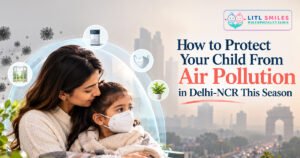
Every October, parents ask me which mask to buy, whether a purifier is worth the money, and whether the products they see online work at all. This guide answers those questions one by one. If you want the full picture of smog safety first, read my guide on protecting your child from air pollution in Delhi-NCR.
Do masks protect kids from smog?
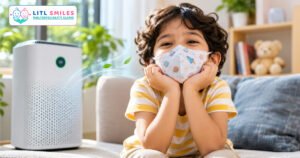
Yes, but only when the mask seals well. Fine smog particles (PM2.5) slip through gaps around the nose and cheeks. A child’s face is smaller than an adult’s, and it changes quickly, so a mask that fit last winter may leak this winter. A leaking mask protects your child very little, and it gives you false confidence.
Which mask should my child wear?
Choose an N95, KN95, or FFP2 mask made for children. These masks filter about 95 percent of fine particles when they seal well. Cloth masks, surgical masks, and scarves filter far less, so keep them for cold air, not for smog.
When you shop, follow these rules:
- Pick the size by your child’s face, not by age. Check the maker’s size chart.
- Look for the filter standard (N95, KN95, or FFP2) printed on the pack. Skip unlabelled “anti-pollution” masks.
- Choose adjustable straps and a soft nose clip.
- A mask with an exhalation valve makes breathing out easier. It still filters the air your child breathes in.
- Skip adult masks on small faces. They leak at the edges.
- Skip masks with battery-powered fans. They are heavy for children, and I do not see proof that they work better.
Most respirators made for children suit ages five and above. A mask is not right for every child. Young children often cannot keep a tight mask on, and they cannot always tell you when they struggle to breathe. Use a mask only when the AQI is poor, your child is old enough, and the mask fits.
How do I check that the mask fits?
- Press the nose clip so it hugs the sides of the nose, and adjust the straps until the mask feels snug.
- Ask your child to breathe out gently.
- Run your hand around the edges. Feel for air leaking near the nose, cheeks, and chin.
- If you feel air, adjust the straps or try another size or shape.
- Let your child talk, walk, and breathe in the mask at home for a few minutes before the first outing.
Replace the mask when the straps loosen, or when it gets wet, dirty, or damaged. Replace it sooner if breathing through it feels harder than before.
Who should not wear a mask?
- A child under two years old. A mask can interfere with breathing.
- A child who is asleep, or who cannot take the mask off without help.
- A child who panics, cries, or keeps pulling the mask off.
- A child with a lung, heart, or breathing problem, unless your doctor has approved a mask.
Remove the mask at once if your child coughs hard, feels dizzy, or struggles to breathe. On bad air days, staying indoors protects babies and toddlers better than any mask.
Do air purifiers really work for kids?
Yes, when you use a true HEPA purifier in a closed room. Children spend most of the day indoors, and the bedroom is where they spend the longest unbroken stretch, so that room gives the biggest benefit. A purifier lowers the fine particles inside one room. It does not clean the whole house, and it cannot keep up when the windows stay open.
How do I choose the right purifier?
- A true HEPA filter. A true HEPA filter captures at least 99.97 percent of particles of 0.3 micron. Be careful with labels such as “HEPA-type” or “HEPA-like.”
- The right size for your room. Check the CADR (clean air delivery rate) on the pack. As a simple rule, choose a purifier with a CADR of at least two-thirds of your room’s floor area in square feet, for a standard ceiling height.
- No ozone. Choose a purifier that relies on a filter. Avoid models that add ionisers, plasma, or ozone.
- Filter cost and availability. Ask what a replacement filter costs and where you can buy it before you buy the machine. A purifier with an old filter does little.
- Low noise. Your child should sleep comfortably with it running on a low setting.
Where should I place the purifier, and how long should I run it?
- Place it in the room where your child sleeps.
- Keep doors and windows closed while it runs.
- Leave space around the machine, and keep it a few feet away from the bed. Do not block the air outlet with curtains or furniture.
- Run it continuously during smog season. A purifier cleans the air only while it is on.
- Clean the pre-filter and change the main filter on time, as the manual says. Filters clog faster in NCR winters.
- Open the windows briefly when the AQI is lower, usually around midday, and then close them again.
Do I need a humidifier too?
Not for smog. A humidifier adds moisture, not clean air. Dry winter air can irritate the nose, but a dirty humidifier can grow mould and bacteria, and that can worsen asthma and allergies. Use one only if your doctor advises it. If you do, empty and rinse it every day, and follow the maker’s cleaning steps.
Which products and habits waste money?
- Ozone generators and some ionisers. Ozone irritates the lungs and can trigger coughing and asthma.
- Essential-oil diffusers, incense sticks, camphor, room sprays, and scented candles. They add particles and fumes to the air.
- Indoor plants. A few pots cannot clean a room’s air in any meaningful way.
- Steam, kadha, turmeric milk, and special foods. None of these protect the lungs from smog.
- A purifier in a room with open windows. The machine cannot keep up with the polluted air coming in.
- A mask for the school run, but dirty air at home. Your child spends far more hours indoors.
My child has asthma or allergies. Do a mask and purifier replace medicine?
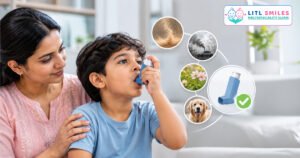
No. Children with asthma and allergies feel the effects of smog first. A mask or purifier helps, but neither replaces your child’s prescribed medicines. Keep giving the controller medicine exactly as your doctor advised, and keep the reliever inhaler within reach.
Smog is only one of many triggers. Read my guide on asthma triggers and inhaler myths to learn what else can set off symptoms. If your child coughs for weeks, check these hidden signs that a chronic cough may be asthma. A child allergy specialist in Greater Noida West can also build a personal plan for your child.
What about grandparents and other adults at home?
The same rules apply to everyone in the house. A fitted N95 mask, a HEPA purifier, and a smoke-free home help adults too. Adults with asthma, heart disease, or lung disease should ask their own doctor before they rely on a mask for long outdoor trips.
Buy, check, or skip? A quick checklist
| Decision | Item | Why |
| Buy | N95, KN95, or FFP2 mask in your child’s size (age 5 and above) | It filters about 95 percent of fine particles when it seals well. |
| Buy | True HEPA purifier with the right CADR for the bedroom | It cleans the air your child breathes for the longest stretch. |
| Buy | Spare masks and spare filters | Dirty or loose ones protect less. |
| Check | Mask fit before every outing | A leak removes the protection. |
| Check | Replacement filter cost and availability | An old filter does little. |
| Check | Humidifier use | Ask your doctor first. |
| Skip | Cloth and surgical masks for smog | Fine particles pass through. |
| Skip | Any mask for a child under two years | It can interfere with breathing. |
| Skip | Masks with battery fans, and unlabelled masks | Fan masks are unproven and heavy, and unlabelled masks have an unknown standard. |
| Skip | Ozone generators and ionisers | Ozone irritates the lungs. |
| Skip | Diffusers, incense, camphor, and room sprays | They add particles and fumes. |
| Skip | Plants, steam, kadha, and special foods | They do not protect the lungs from smog. |
When should you see the doctor?
Book an appointment if your child has any of these signs:
- A cough that lasts more than two weeks, or one that wakes your child at night
- Wheezing or breathlessness during play
- Repeated colds that settle in the chest
- Red, watery eyes or a sore throat that does not go away
A paediatric doctor in Greater Noida West can examine your child and plan the right care. Not sure whether your child needs a specialist? Read when your child should see a child specialist.
Go to the nearest hospital immediately if your child has:
- Fast breathing, or the chest and ribs pulling in with each breath
- Trouble speaking, feeding, or playing because of breathlessness
- Blue or grey lips or face
- No improvement after the reliever your doctor prescribed
- Unusual sleepiness or unresponsiveness
Quick answers to common questions
How long can my child wear a mask?
Short trips, such as the commute, are fine. Give your child breaks in clean air, and remove the mask if your child feels uncomfortable.
Is it safe to sleep with an air purifier on?
Yes, if the purifier is filter-based and does not make ozone. Choose a quiet model and keep the cord out of your child’s reach.
Can I run the purifier and the AC together?
Yes. Keep the doors and windows closed so the purifier cleans the same air again and again.
How often should I change the filter?
Follow the maker’s schedule, and change it sooner if the air still smells dusty or the filter looks dark. A clogged filter cleans very little.
Need help protecting your child this season?
If your child coughs, wheezes, or struggles to breathe when the air turns bad, do not wait for it to pass. If you live in Greater Noida West, book an appointment with Dr. Nivedita Kapoor at Litl Smiles Multispeciality Clinic.
This article gives general information. It does not replace your doctor’s advice. In an emergency, go to the nearest hospital.
About the Author: Written by Dr. Nivedita Kapoor (MBBS, MD, DCH), Reg. No. MP 6585. Pediatrician at Litl Smiles Multispeciality Clinic, City Galleria, Gaur City-2, Greater Noida West.