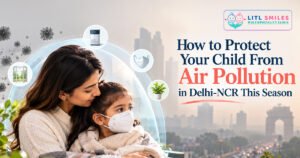
Come around late October and the air in the NCR begins to take on a different form. It’s in the early morning mist, the burning sensation in your eyes while driving to school, and the dry cough that your child just can’t get rid of. Parents complain to me about feeling helpless since there isn’t much one can do about the polluted skies.
Yes, but there are things that you can do that you might be unaware of. And most of these measures cost nothing and are easy to undertake. Let me show you how.
The reason children have it worse than us
The lungs of a child are developing. There are fewer air channels that become constricted when the child is exposed to dust and smoke and makes breathing difficult. Children also breathe faster than adults, meaning that they inhale a larger amount of polluted air relative to body size. Think about how they behave during the day, playing and running, breathing deeply. Each of these breaths will inhale what’s in the air.
Infants and toddlers have yet another issue because they spend time on the floor.
Look at AQI just like you look at the weather forecast
Develop the routine of checking the AQI every morning. All you need to do is check the weather report where the Air Quality Index for your city is included. Here’s how I would interpret the information:
| AQI | What to do |
| 0-100 | Typical day. Let them play outside. |
| 101-200 | Safe for healthy kids but those with allergies and asthma have to be careful. |
| 201-300 | Limit outdoor activities and keep the windows closed. |
| 301-400 | Take the play inside. In case you have to go out, wear a face mask. |
| Over 400 | Stay indoors as much as possible and cancel outdoor school classes. |
Begin with your house
Your child will be spending most of the day indoors, and hence, this is where the most changes can be made.
- Close your windows in the early morning hours and in the evening when the quality of the air will be the worst. Only if the AQI permits, then you may open them during midday.
- Mop the floor using a wet cloth rather than sweeping. Sweeping will only spread dust in the air.
- No use of incense sticks, mosquito coils, or camphor in the rooms where children spend time.
- There should be no smoking near the child either in another room or in the car.
- Activate the chimney or exhaust fan while cooking food.
- Washing the bed sheets and soft toys regularly is important because of the dust mites.
Outdoor play and schooling
I am definitely not going to advise you to lock up your kid in his room for two months because that is impossible and kids need some activities. Let the AQI tell you what to do with it.
If the day is good, take him out and choose midday time instead of morning or evening. On bad days, try some indoor activities such as dancing, rope jumping, yoga, or board games. It may be useful to consult your children’s school to see how they act during assemblies and sporting activities in days of high AQI.
Face washing and hands washing is good when your kids get back home, and if his nose is clogged, saline drops can help.
Masks: Which ones are worth purchasing
Cloth masks and regular surgical masks provide little protection against tiny particles. N95 and FFP2 masks that fit tightly will be more effective, and it should fit your child. Otherwise, you’ve paid for nothing, since leaking air means no protection.
Masks should not be worn by babies and young children below two years old, since they may interfere with breathing. On a bad air day, the best course of action will be to remain indoors. If your child has difficulty breathing or does not tolerate masks, consult your pediatrician.
Do air purifiers work?
They do, but particularly in the room where your child sleeps. However, choose one wisely. Find a genuine HEPA filter that will fit the room size, close all the doors and windows while the filter is on, and don’t forget about timely changing of the filter. Also, be careful with ozone-producing machines as ozone irritates lungs.
It’s good for you, but it doesn’t substitute anything from the list above. It also can’t serve as an excuse to avoid visiting the doctor.
If your child already has asthma or allergies
They are the children who feel it first. Just some of what I always say to parents:
- Don’t stop the prescribed medication because your child seems to be fine. It works only when taken continuously.
- Keep the reliever inhaler (as per prescription) accessible – both at home and in the school bag.
- Never change the dosage or start new medication without the doctor’s advice.
- Consult the doctor immediately when you find that your child is having night-time cough or wheezing during play, rather than waiting for it to become serious.
And if your child has a cough that won’t go away, it could be something more than just a common cold. You may want to check out my article on the silent signals of asthma masquerading as chronic cough.
A word about Diwali
The period surrounding Diwali is one of the worst for air pollution in the NCR. The cracker fumes can trigger an asthma attack and linger even when the sound pollution is gone.
So my advice is straightforward. Avoid any crackers and do not expose your child to environments where crackers are bursting, no matter how innocuous it seems from afar. Keep the windows closed in the evenings and switch on the purifier if you have one. Make it a safe and healthy festival, full of lights and rangolis, sweets and indoor games. If your child suffers from asthma, make sure you monitor them carefully for the next couple of days. Burns are common during this season, so it’s best to have a first-aid kit handy.
Time to consult a doctor
Plan an appointment if your child suffers from any of the following symptoms:
- Cough that lasts for more than two weeks, or a cough that makes your child wake up at night.
- Persistent wheezing or difficulty breathing during play.
- Repeated attacks of cold followed by chest complaints.
- Irritated and red eyes, or pain in throat that persists.
Visit the nearest hospital immediately if your child shows the following symptoms:
- Rapid breathing, or sucking in of chest and ribs during breathing.
- Unable to breathe or feed properly due to difficulty in breathing.
- Blue lips and face color.
- Very sleepy or unresponsive to the reliever inhaler provided.
If you are confused as to when your child needs to be seen by a specialist, then here is when your child needs to see a child specialist.
Common Questions Parents Ask Me
Is it okay for me to take my kid to school on polluted days?
It is fine in case of moderately polluted days, while on severely polluted days, try to request the school to arrange indoor activities, especially for an asthmatic child who is unwell.
Should I give my kid a medicine for a cough caused by pollution?
Please do not give medicines like cough syrups without consulting a physician first. Many times, the cough tends to reduce on its own after the exposure ends.
Does pollution cause asthma?
Chronic exposure to polluted air increases the risk of having asthma, while it definitely worsens the already existing condition of asthma.
Do plants, steam or special foods have any protection for the lungs?
There is no scientific evidence to show that plants or special foods can help protect your lungs.
Are you looking for help for your kid this season?
Does your kid have a cough, wheeze or difficulty breathing as the air quality worsens? Don’t wait and let it pass by itself. If you are from Greater Noida West, then book an appointment with Dr. Nivedita Kapoor.